Scriptly Helps Pharmacies Identify Trends in Real Time with Reveal

Explore the complete guide to embedded analytics, including architecture, security, AI capabilities, implementation patterns, and evaluation criteria for modern applications.
Read Now
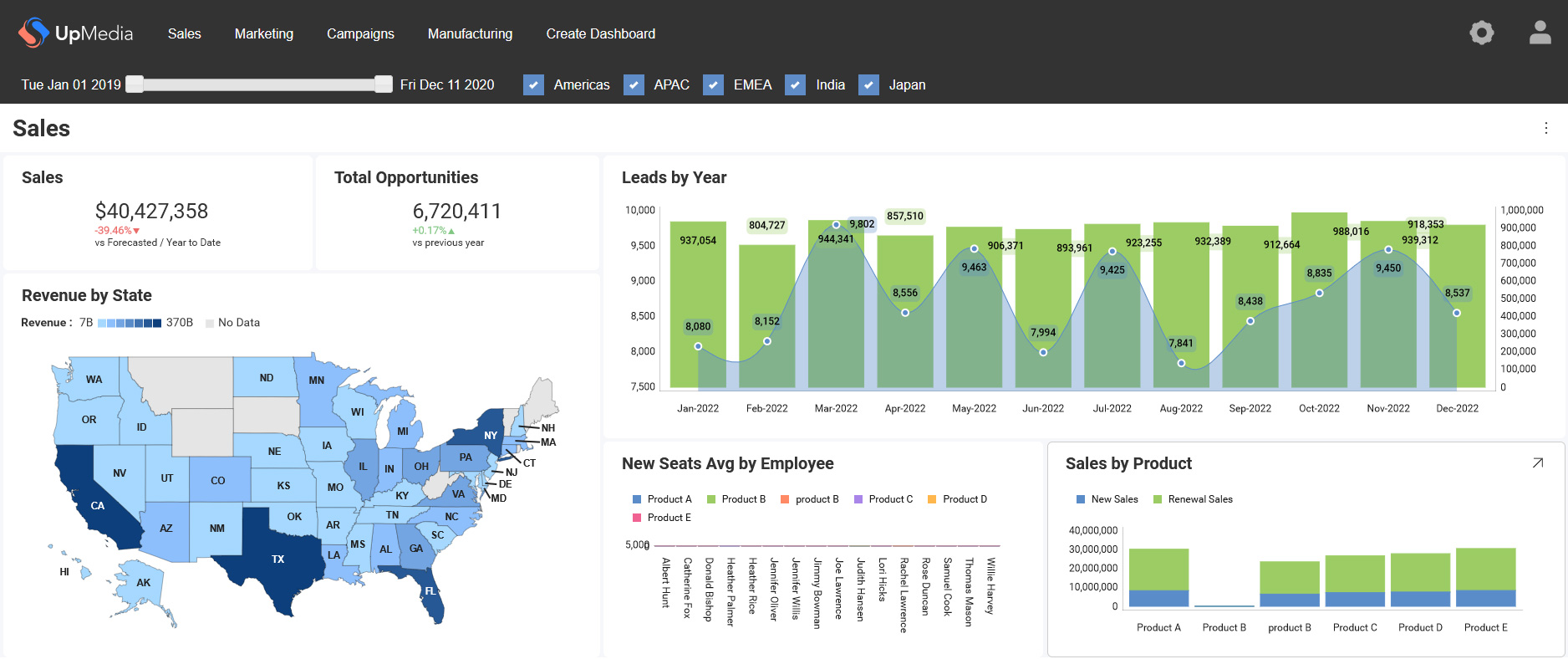
Fully branded white label dashboards offer custom personalization so that your customers can present a holistic service that is all branded to one company.
Read Now Reveal is a white-label embedded analytics SDK that lets SaaS companies and ISVs ship fully branded dashboards, reports, and AI inside their own apps — every color, font, component, and interaction. Your customers never know it's a third-party tool. They see your product.
White-labeled by default. No add-on required. No visible Reveal branding — ever.

TRUSTED BY SAAS TEAMS DELIVERING FULLY BRANDED ANALYTICS TO THEIR CUSTOMERS









THE PROBLEM
They give you a color picker and a logo swap. You change the brand colors. Maybe you get a custom domain if you're on the right pricing tier. But the component behavior is the vendor's. The interaction patterns are the vendor's. The AI interface, if there even is one, is the vendor's. The moment a customer looks closely, they can tell the analytics section of your product was built by someone else.
Weighing your options? See how the leading tools compare in our guide to the 5 best white-label analytics platforms.

01
Full control over colors, fonts, layouts, component behavior, and interaction patterns, down to the button style. Reveal's SDK integrates directly into your application's component tree, which means the analytics layer inherits your design system rather than imposing its own. Your customers see your product, not a rebranded dashboard tool.
02
Most white label analytics platforms charge per user, per query, or per data volume, which means the more customers adopt your analytics, the more expensive it gets. Reveal's fixed pricing includes unlimited users and usage. One predictable number, regardless of how fast your product grows or how widely your customers engage with their data.
03
Reveal AI gives your customers conversational analytics. Ask a question, get an answer, see the data fully embedded through your SDK, under your brand, governed by your existing authentication and permission model. It's not a separate AI tool that your customers switch to. It's AI that behaves as if it were built by your team.

The difference matters more than most teams realize, until a customer notices the analytics section doesn't quite match the rest of the product, or until the design team asks why they can't customize a specific interaction, or until the AI interface breaks the visual consistency that everything else in the product maintains.
| Capability | Reveal | CSS theming / iFrame white label |
|---|---|---|
| Brand colors and fonts | Full design system control | Basic theming |
| Component-level UI behavior | Every interaction, every element | Not accessible |
| Third-party branding visible | Never — white-labeled by default | Often — unless you pay extra |
| Your own domain | Fully supported | Sometimes, add-on cost |
| Matches product design system | SDK renders inside your component tree | Partial — CSS only |
| AI that inherits your brand | Conversational AI under your brand | Separate interface |
| Multi-tenant data isolation | Query-level enforcement | UI-level filtering |
| Pricing as users grow | Fixed — no penalty for growth | Per-seat or usage-based |

Reveal's SDK integrates with your application's component tree, including React, Angular, .NET, Blazor, and more. The analytics layer doesn't have its own visual language applied to your product. It inherits yours. Colors, fonts, spacing, interaction states, hover behavior, all of it is defined by your design system, not overridden by a third-party theme.
Avion, a SaaS platform for product teams, needed to deliver analytics to customers across dozens of markets, all expecting the analytics experience to feel like a native part of the Avion product. Building a white-label analytics layer that matched Avion's design system, scaled across their customer base, and stayed consistent as the product evolved was beyond what their engineering team could maintain alongside core product development.
Avion embedded Reveal's SDK directly into their platform. The analytics layer inherited Avion's design system through the SDK integration, not through CSS overrides applied to an iFrame. White-label theming was consistent across every chart, dashboard, and interaction without requiring ongoing design maintenance. Customers accessed real-time data inside the Avion product with no visible trace of a third-party tool.
Avion scaled branded dashboards across a global customer base without adding developer overhead. Analytics adoption improved because the experience was consistent with the rest of the product. There was no context shift, no re-learning, no moment where customers noticed they were looking at something that wasn't Avion. The feature became a retention driver, not just a capability checkbox.
Read the Avion story →
“The openness of the technical team at Infragistics to take our suggestions and implement them to make the product even better is part of the reason we chose Reveal. It's this willingness to innovate and improve that takes our partnership to the next level.”


It's unusual for a software vendor to make improvements on a product so quickly. It can take months or years for vendors to make fixes or add new features requested by a customer.

The Reveal implementation process took about a week. We were up and running with self-service analytics in the blink of an eye.


There's no white label add-on tier. There's no Reveal branding that gets removed when you upgrade. Reveal is fully white-labeled out of the box because it integrates at the SDK layer, where your product's design system governs everything. Your customers see your product from the first screen to the last interaction.

White labeling through CSS overrides on an iFrame has a ceiling. SDK integration doesn't. When your design team asks for a change to how a specific chart type behaves on hover, or how a filter interaction animates, or how the AI response panel integrates with the surrounding UI, Reveal's SDK can do it. An iFrame cannot.

Per-tenant theming and per-tenant data isolation run through the same architecture. Customer A sees their brand and only their data. Customer B sees theirs. Neither requires a separate deployment, environment, or configuration process. It scales because the architecture supports it, not because your team maintains it manually.

White label analytics that succeed mean customers use them. Usage-based pricing punishes that success. Reveal's fixed pricing means your analytics costs stay predictable whether ten customers are active or ten thousand. The number on your invoice doesn't change because the feature worked.
See pricing →