Scriptly Helps Pharmacies Identify Trends in Real Time with Reveal

Explore the complete guide to embedded analytics, including architecture, security, AI capabilities, implementation patterns, and evaluation criteria for modern applications.
Read Now
Fully branded white label dashboards offer custom personalization so that your customers can present a holistic service that is all branded to one company.
Read Now Struggling with dashboard adoption? Learn why users ignore dashboards and how embedded analytics drives real usage and better decisions.
Executive Summary:
Product teams rarely struggle to build dashboards.
They struggle to get anyone to actually use them.
You ship analytics. The data is accurate. The visualizations look good.
But a week later, usage drops off, and your dashboards quietly become shelfware.
This isn’t a tooling problem. It’s a usage problem. A dashboard adoption issue.
Most dashboards are designed for reporting, not for decision-making. They live in a separate tab, and they require users to stop what they’re doing.
And they assume users know when and why to check them.
But that’s not how people work.
Users don’t wake up thinking:
“Let me go check a dashboard.”
They act when something in their workflow requires it. If analytics aren’t part of that workflow, they don’t get used.
Across product teams, the pattern is consistent:
Why?
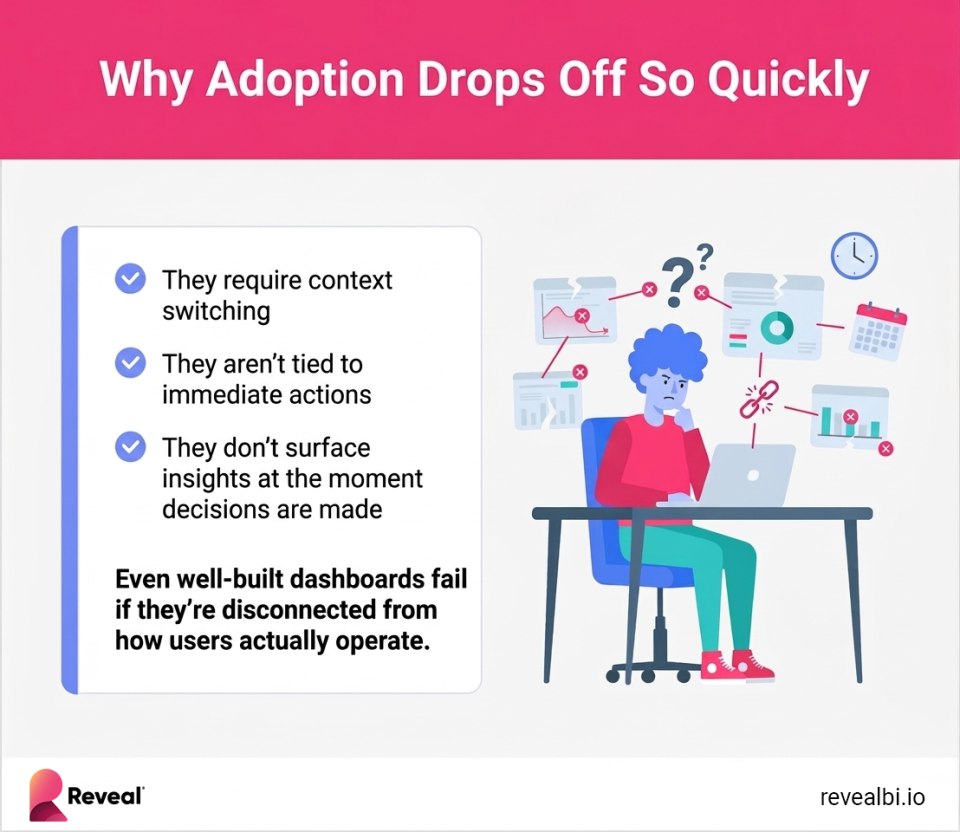
Because dashboards introduce friction:
Even well-built dashboards fail if they’re disconnected from how users actually operate.
The products that see real analytics usage don’t treat dashboards as destinations.
They treat analytics as part of the product experience.
That means:
This is the shift from: “Here’s your data”
to “Here’s what you should do next”
If your goal is adoption, the question isn’t:
“Do we have dashboards?”
It’s:
“Are our users actually using data to make decisions?”
That requires rethinking how analytics are delivered:
This shift is becoming even more important as teams layer AI into analytics.
Because AI doesn’t fix unused dashboards, it amplifies the problem if usage isn’t there to begin with.
If users aren’t engaging with your data today, adding AI won’t change that.
But embedding insights into workflows that will.


 Return to Blog


 ChatGPT
 Perplexity