Explore the complete guide to embedded analytics, including architecture, security, AI capabilities, implementation patterns, and evaluation criteria for modern applications.
White-Label Software and Analytics: Enhancing Your Brand
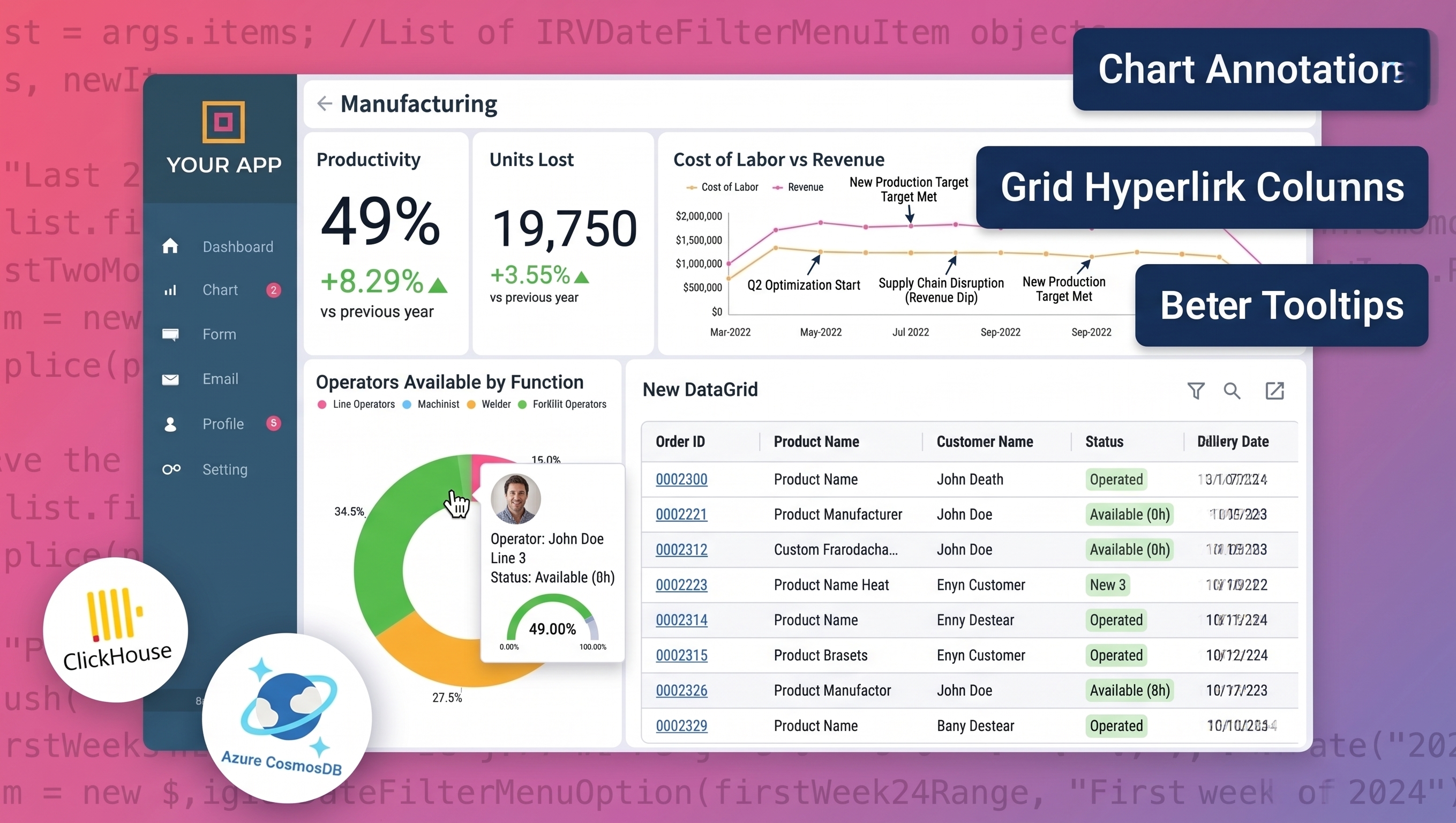
Fully branded white label dashboards offer custom personalization so that your customers can present a holistic service that is all branded to one company.
The Promise and Perils of AI in 2025: Insights from Software Development Leaders
AI is no longer experimental. It’s imperative for software development.
As AI reshapes how software is developed, it’s also redefining what’s possible—and highlighting the risks. The winners in this next era of software development will not be those who adopt AI the fastest, but those who govern it the smartest.
Reveal’s 2025 Software Development Challenges Survey Research Report explores how leading CIOs and CTOs are managing the AI transition, formalizing oversight, identifying high-value use cases, and building disciplined strategies for scale.
From productivity enhancements to governance gaps, this study delivers a candid look at the realities of AI in production—and what technology leaders must do to stay ahead. Our report analyzes the top 7 findings from the Reveal research and provides actionable insights for taking advantage of AI’s full potential.
Survey Findings at a Glance
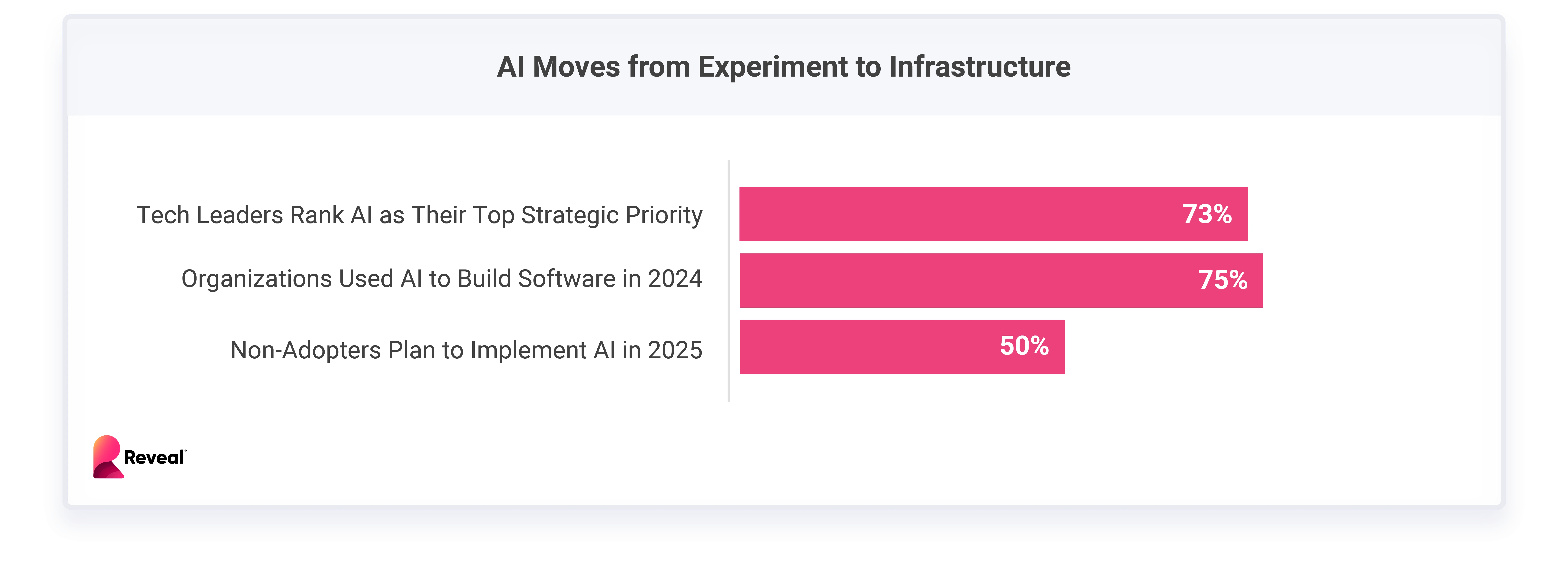
AI Dominates the 2025 Agenda: 73% of tech leaders rank AI as their #1 strategic priority in 2025.
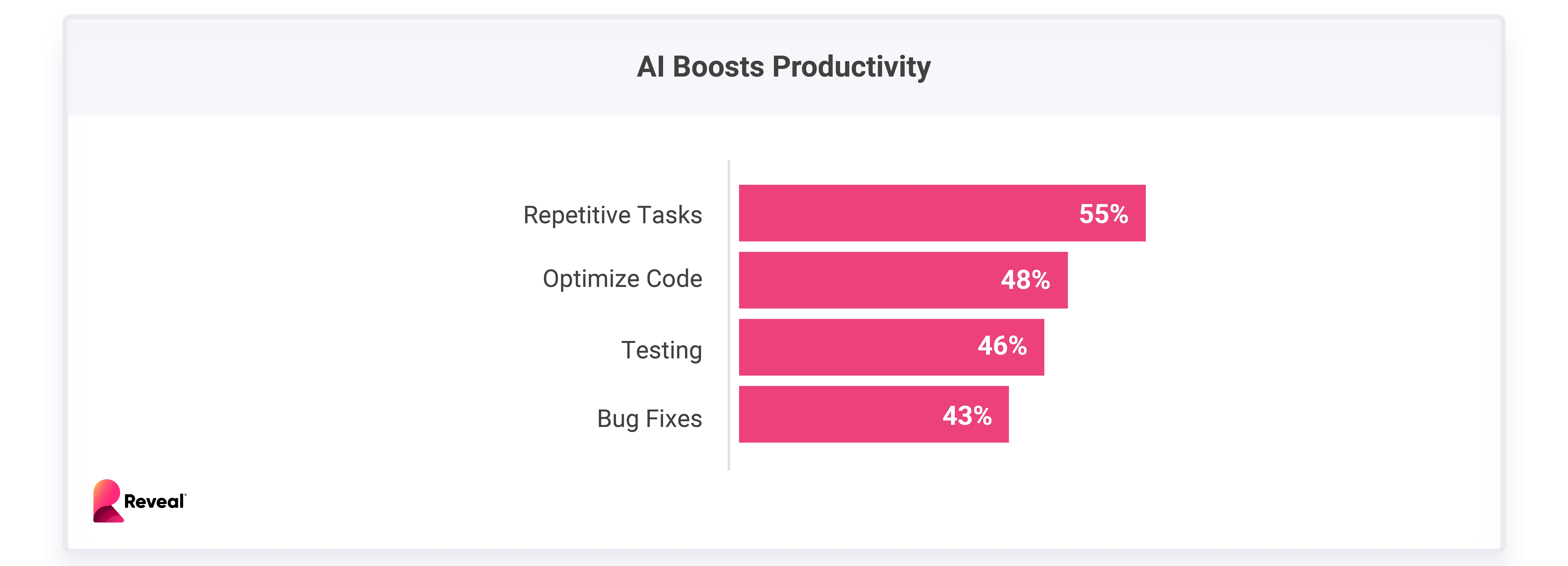
Productivity Gains Are Real: 55% of teams automate repetitive dev work with AI.
Governance is Lagging: 47% report increased attack risks; 35% cite trust issues with AI output.
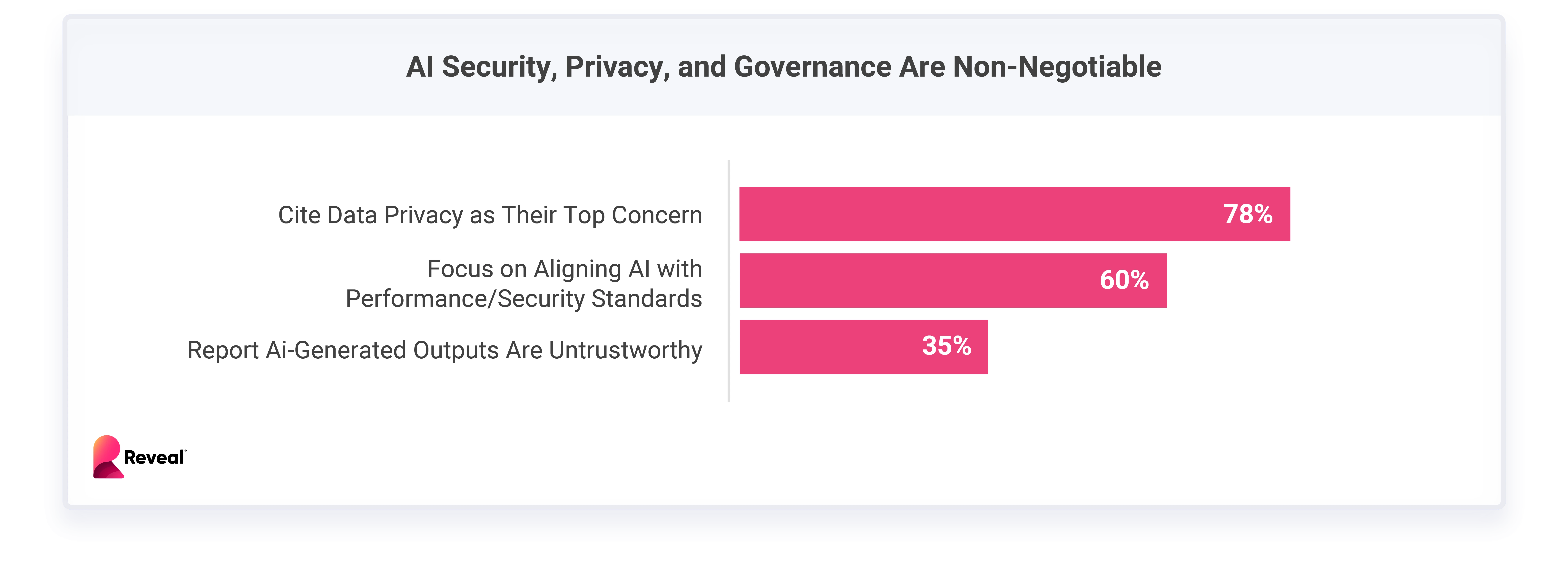
Security & Ethics Are Now Front and Center: 78% list data privacy as their top AI concern.
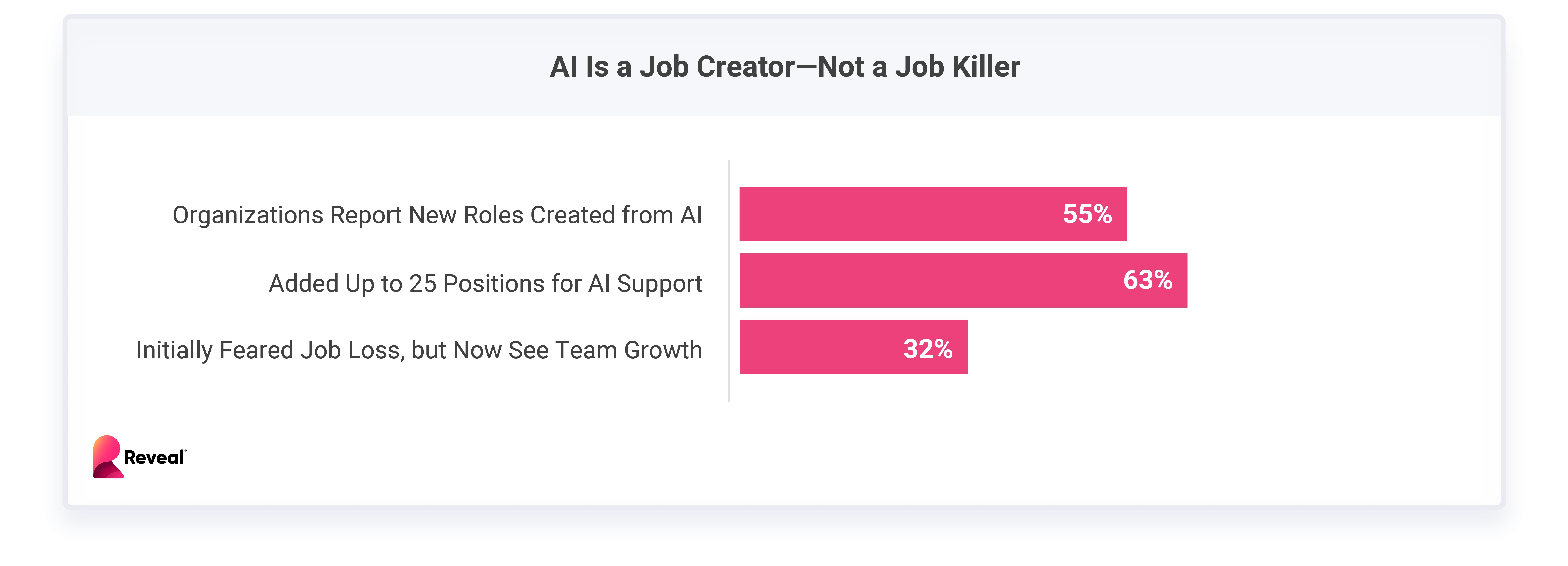
AI Is Creating, Not Cutting, Jobs: 55% of organizations have added roles to support AI adoption.
Continue Reading
Fill out the form to continue reading.
Form submitted
AI Moves from Experiment to Infrastructure
AI has outgrown its experimental phase. No longer confined to innovation labs, AI is now a central pillar of enterprise strategy, integrated deeply into infrastructure, decision-making, and product development.
Key Takeaway:
Forward-looking tech leaders are treating AI as part of their infrastructure. The most effective leaders are integrating AI across their engineering stack—creating velocity and resilience with fewer resources. Those who operationalize AI are building more efficient, scalable systems that will define the next generation of software development.
AI Boosts Productivity
AI is delivering on its promise to enhance productivity—especially in development cycles. Teams are shipping faster, reducing QA time, and automating code optimization, testing, and debugging. Engineering efficiency is up—without headcount growth.
Key Takeaway:
AI is accelerating development in meaningful ways. The positive impact of AI on development speed is real. Teams adopting AI are minimizing repetitive engineering tasks, giving developers more time to focus on solving complex problems and driving product innovation.
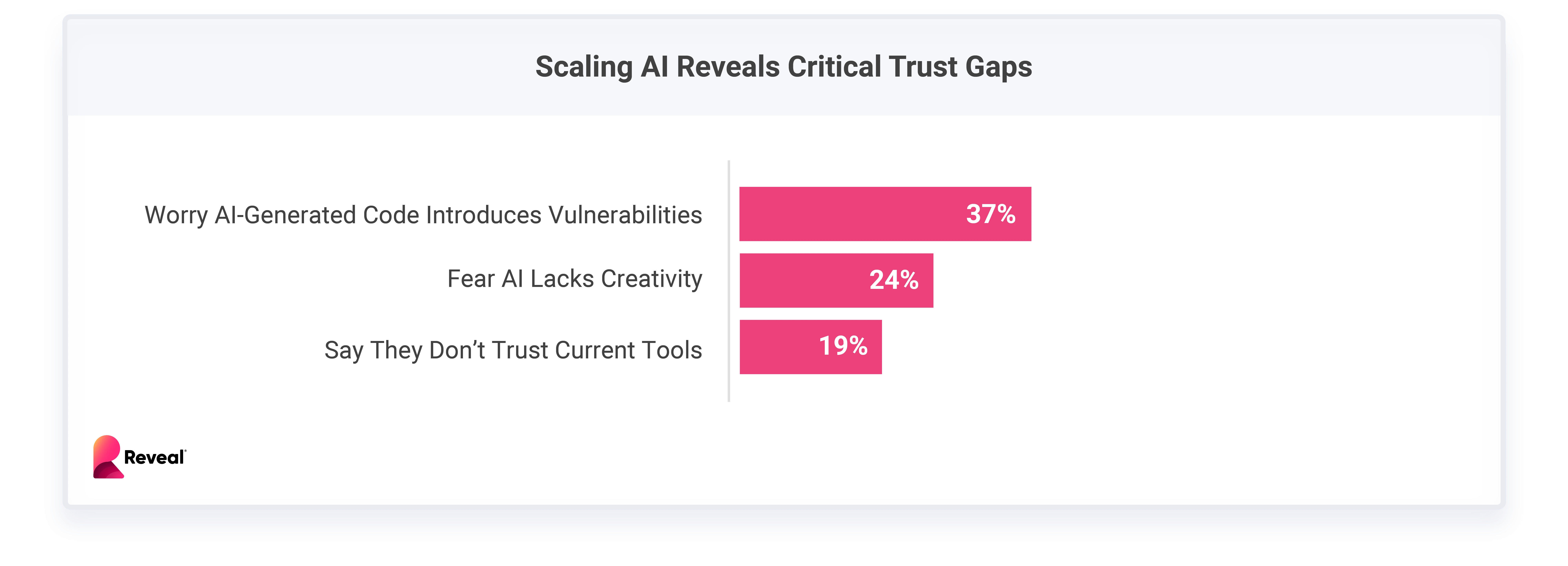
Scaling AI Reveals Critical Trust Gaps
AI-driven productivity gains are real but they come with trade-offs. As adoption scales, technical concerns are emerging around code reliability, logic integrity, and system predictability. AI adoption alone isn’t enough. Developers and leaders are raising red flags as these concerns are slowing expansion and raising doubts across leadership. This requires robust oversight.
Key Takeaway:
Confidence is now the currency of AI adoption. Without quality assurance and explainability, AI will stall under its own weight. AI’s future in engineering depends on trust. Without strong guardrails around quality, safety, and explainability, adoption will decline—especially at scale.
AI Security, Privacy, and Governance Are Non-Negotiable
Developers can’t scale AI without safeguards. As systems move into production, unaddressed risks—like data exposure, biased outputs, and unclear accountability—become roadblocks to both adoption and credibility.
Key Takeaway:
Trust isn’t a feature—it’s a requirement. Responsible AI must be secure, explainable, and governed from day one.
"AI doesn’t fail because of its capabilities—it fails because teams haven’t integrated the protections to use it responsibly."
Jason Beres, COO, Infragistics
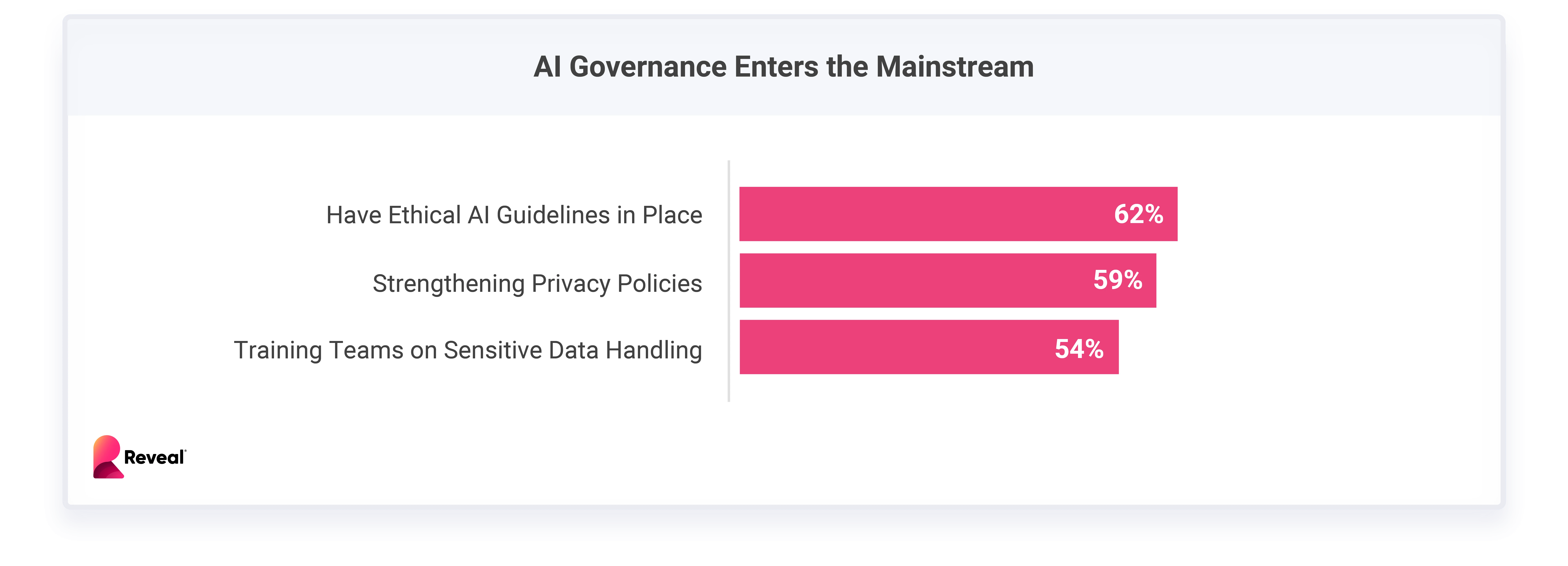
AI Governance Enters the Mainstream
AI has reached a turning point, shifting from exploration to discipline. Enterprises are formalizing their AI governance with ethical standards, data privacy protections, and workforce readiness to ensure scalable, responsible growth.
Key Takeaway:
As AI implementation continues to rise, software developers have a responsibility to keep data privacy and security at the forefront to protect their customers. The security, reliability, and integrity of AI has become increasingly vital.
"As software evolves and we enter an era of agentic AI, user confidence in the security, reliability, and integrity of digital interactions and technologies has become increasingly vital. We are facing a complex threat landscape where even advanced software struggles to keep up with modern cyber-attacks, sophisticated threats, and privacy and security challenges. The tech sector has a responsibility to address these risks by integrating protections into their solutions."
Jason Beres, COO, Infragistics
AI Is a Job Creator—Not a Job Killer
New tech, new roles. AI is reshaping teams, not replacing them. As AI systems become embedded in software development, organizations are hiring and reskilling for testing, compliance, automation oversight, and system training roles as they build the teams needed to scale AI responsibly.
Key Takeaway:
Success with AI requires the right people. Tech leaders must invest in talent that can manage AI workflows, ensure compliance, and drive adoption with confidence.
Navigating the Promise and Perils of AI
Deploying AI at scale isn’t just a technical challenge—it’s a mandate for today’s CTOs and CIOs. Technology leaders must create the structure and processes that support repeatable, safe, and high-ROI AI. That means embedding AI into core workflows and building a foundation of trust, security, and performance.
Your AI Leadership Checklist
• Build governance models and assign ownership
• Prioritize proven, high-ROI use cases
• Train your teams on secure and ethical AI practices
• Establish privacy and ethics standards
"Our survey indicates that many CTOs and CIOs underestimated the complexity of AI deployment and they are finding that adoption alone isn’t enough. Execution determines success or failure. Early adopters who rushed AI integration without a strategy are facing fragmented systems, inefficiencies, and unpredictable performance. Without a clear AI strategy, companies are at risk—not because they failed to adopt AI, but because they failed to scale and combat the challenges AI presents."
Jason Beres, COO, Infragistics
Conclusion
AI experimentation is largely over. We are now in the execution phase and not every organization will make the transition successfully unless they have a well-defined AI approach.
As AI moves from proof-of-concept to production, the role of the CTO and CIO is even more critical. AI is no longer about isolated innovation; it’s about architecting systems, processes, and teams that can operationalize AI responsibly.
The organizations that thrive will be those led by executives who apply discipline, build trust into infrastructure, and align AI with real business value. Those who delay will encounter rising complexity, security gaps, and a widening competitive gap.
CIOs and CTOs must lead with strategy, not just adoption. By building frameworks, teams, and governance models, we can bring AI from hype to durable impact.
Survey Methodology
A total of 250 technology leaders participated in Reveal’s sixth annual Software Development Challenges survey from December 2024 to January 2025. Infragistics research has been providing a comprehensive analysis of current trends and challenges in software development, business intelligence, and AI adoption, while identifying opportunities for businesses to optimize operations, address emerging risks, and navigate the evolving technological landscape since 2019.
About the Author
Casey Ciniello
Casey Ciniello is a data and analytics-focused product leader at Infragistics, where she drives strategy and innovation for the Reveal embedded analytics platform and the Slingshot work management solution. With a BA in mathematics and an MBA, she brings an in-depth analytical foundation and business perspective to building products that help organizations turn complex data into actionable insights.
Casey leads the development of analytics-driven capabilities, shaping product direction through deep market analysis, user behavior insights, and evolving business intelligence trends. She works closely with customers to understand how data is used in real-world decision-making and translates those needs into intuitive, high-impact analytics experiences. Casey also serves as the Survey Lead for the annual Reveal Software Development Challenges survey, where she analyzes industry data to uncover key trends in analytics, AI, and modern development practices. Her insights and thought leadership have been featured in Dataversity, RT Insights, SaaSXtra, SD Times, Solutions Review, TechStrong IT, App Developer Magazine, Beta News, Integration Developer News, and UX Planet. She is a frequent webinar presenter on modern embedded analytics, machine learning, data visualizations, and scaling SaaS analytics. Casey joined Infragistics in 2013.
Your Privacy Matters:We use our own and third-party cookies to improve your experience on our website. By continuing to use the website, we understand that you accept their use.Cookie Policy.
We use our own and third-party cookies to improve your experience on our website. They also allow us to analyze user behavior in order to constantly improve the website for you. Please review our Cookie Policy and cookie settings below.
When you visit any website, it may store or retrieve information on your browser, mostly in the form of cookies. This information might be about you, your preferences, or your device and is mostly used to make the site work as you expect it to. The information does not usually directly identify you, but can give you a more personalized web experience. Because we respect your right to privacy, you can choose not to allow some types of cookies. However, blocking some types of cookies may impact your experience of the site and the services we are able to offer.
Your Privacy Matters: We use our own and third-party cookies to improve your experience on our website. By continuing to use the website, we understand that you accept their use. Cookie Policy.